Augsburg's Little Secrets: Signs, Symbols, and Mysteries of the City
Why a pine cone became the symbol of Augsburg
Numerous local legends and stories surround the Swiss stone pine and its significance as a symbol of the city of Augsburg. For centuries, scholars have debated where this symbol actually originated and how it came to be adopted as Augsburg’s coat of arms.
Actually, this article seemed like it would be pretty easy: Augsburg, pine cones, Romans, a gravestone—done 😉
But it's not that simple. Let's take a closer look!
The history of the Augsburg pine nut is full of breaks, interpretations, and perhaps even misunderstandings. It’s a mystery that still can’t be fully solved today. Maybe you have a good idea? Then tell us about it!
The Swiss Stone Pine and the Romans
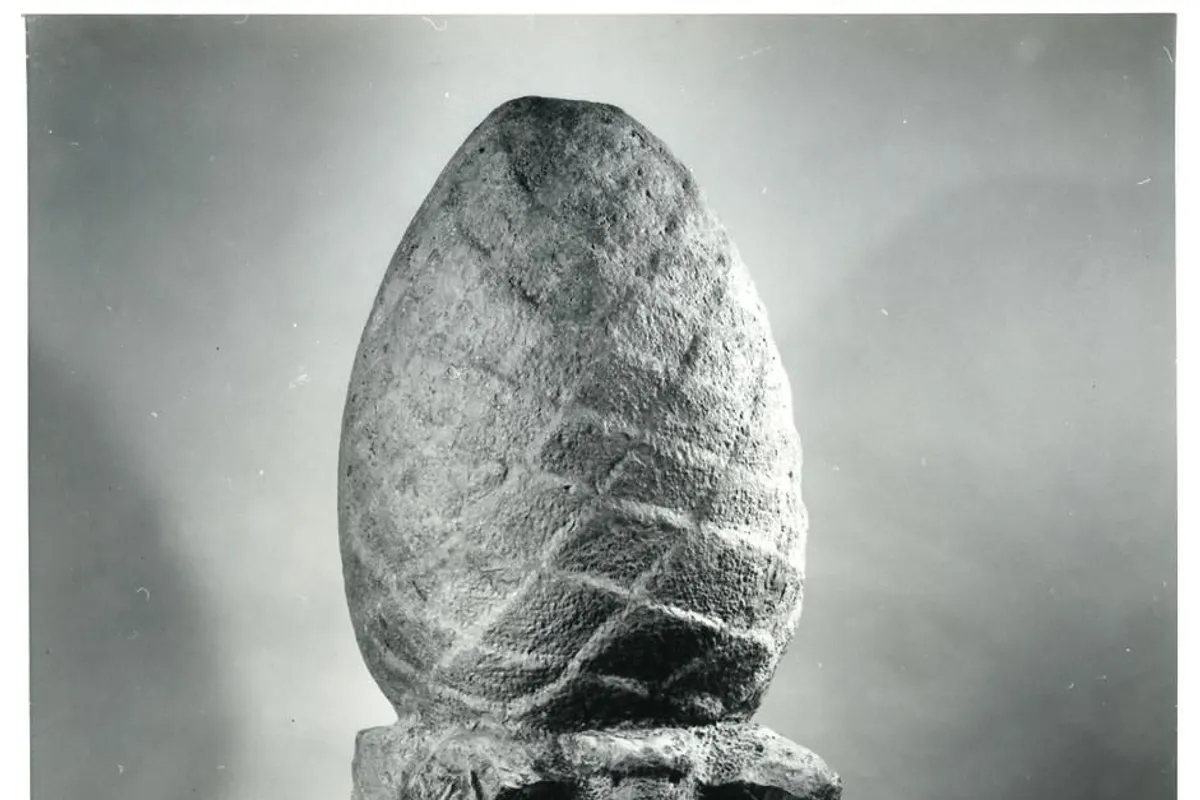
Today, the Swiss stone pine cone is one of Augsburg’s best-known symbols and a feature of the city’s coat of arms. The term “Swiss stone pine cone” refers to the cone of a Swiss stone pine—or a pine tree.
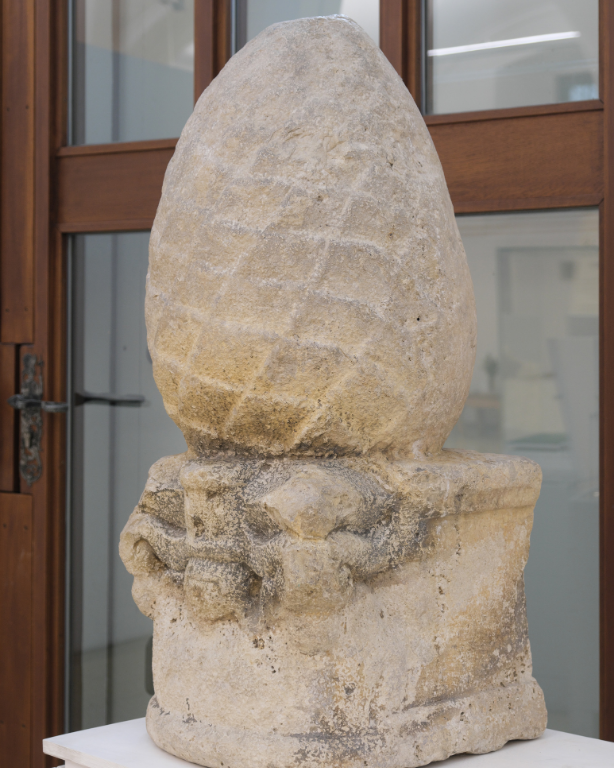
This pine cone carved from Jura limestone is now considered the direct model for the Augsburg city emblem, which has been in use since the late Middle Ages. It was discovered in the 15th or 16th century; its base was likely reworked in the 16th century.
Upon closer inspection, with a little imagination, one can discern the features of a woman’s head between the volutes of the base. Above it is a stylized tower from a city fortification, featuring a gate and two windows. In fact, everything that would later give rise to scholarly discussions and new legends was already present there.
But the original Augsburg coat of arms looked different
However, earlier Augsburg documents make no mention of a pine cone: The oldest known Augsburg coat of arms, dating from 1237, instead depicts a shape that can be interpreted as either a tree or a bunch of grapes on a stem.
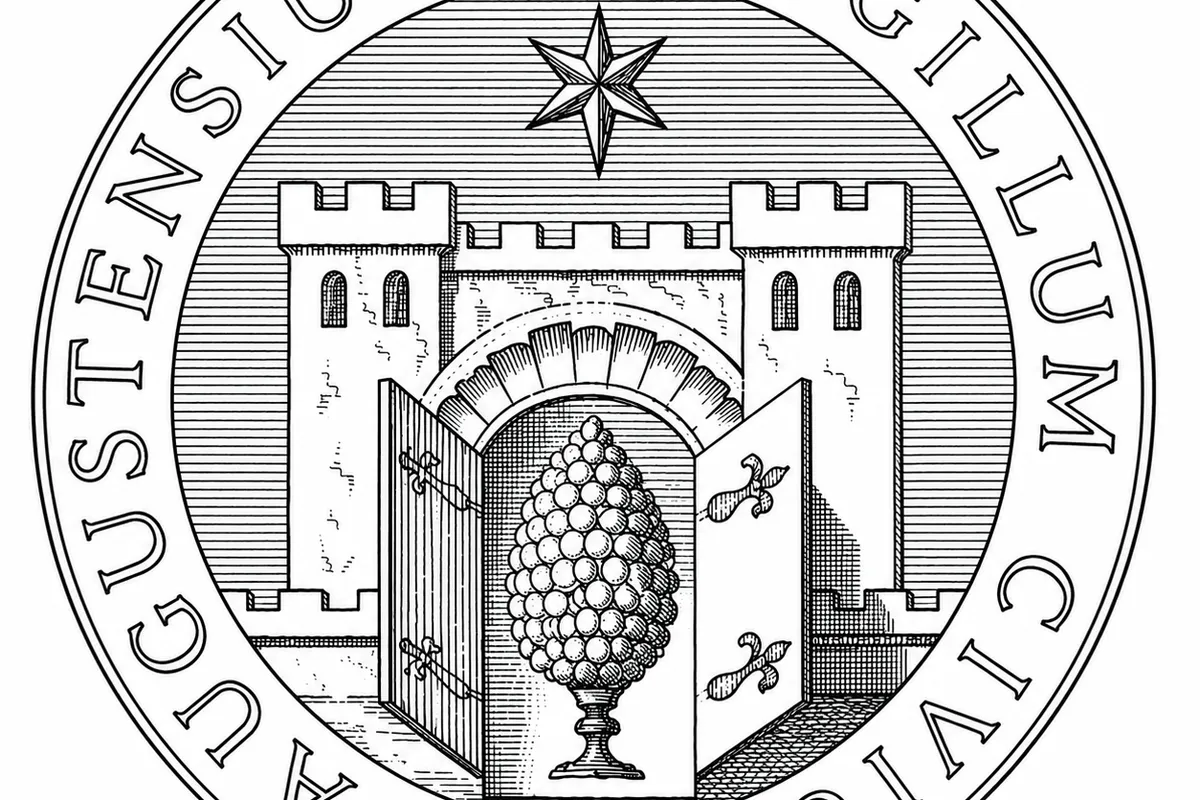
Even the Augsburg city seal from 1260 bears little resemblance to a pine cone. It clearly depicts a cluster of grapes, which sources refer to as “Stadtber” or “Per.” Thus, the Augsburg city emblem was by no means originally interpreted as a pine cone.
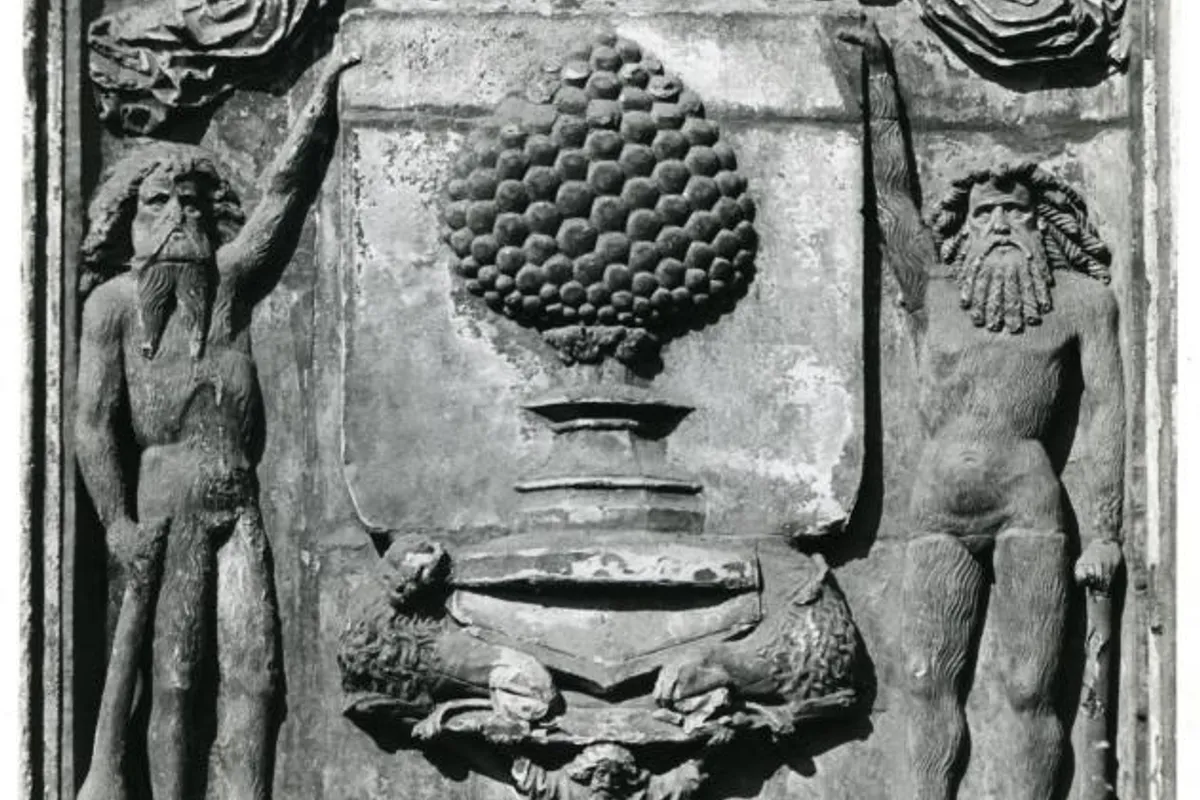
Similarly, the “Wilde-Männer-Tafel” (Wild Men Panel), dating from around 1450, also depicts a berry or a grape. It was once mounted on the Old City Hall and is now located on the back of our “new” City Hall.
The Rediscovery of Antiquity
It was not until the mid-15th century that the Roman artifacts and the pine cones began to hold significance for the people of Augsburg. During construction work and excavations, more and more stones came to light that were attributed to the city’s Roman past. Among them were capitals, architectural fragments, and, in some cases, funerary stelae with their characteristic finials in the shape of pine cones. Thus, people began to associate the finds with Augsburg’s city emblem. The “Stadtber” or “Pyr” was increasingly interpreted as a pine cone.
The Rediscovery of Antiquity
It was not until the mid-15th century that the Roman artifacts and the pine cones began to hold significance for the people of Augsburg. During construction work and excavations, more and more stones came to light that were attributed to the city’s Roman past. Among them were capitals, architectural fragments, and, in some cases, funerary stelae with their characteristic finials in the shape of pine cones. People then began to associate these finds with Augsburg’s city emblem. The “Stadtber” or “Pyr” came to be increasingly interpreted as a pine cone.
Gradually, the idea took hold that the numerous pine cones that had been found had already been an official city symbol during the time when Augsburg was the provincial capital of the Roman Empire. For the councilors of the Imperial City, this interpretation was quite appealing. It seemed to prove that Augsburg’s self-image and its significance could be traced directly back to the glorious Roman era.
But this is precisely where the debate begins: Can Augsburg’s city coat of arms truly be traced in a direct line back to Roman models? Or did these connections emerge only later—out of enthusiasm for the rediscovered ancient world and the desire to trace the city’s history as far back into the past as possible?
This development received a decisive boost from another discovery in 1467. During the construction of St. Ulrich’s Church, the capstone of a Roman pillar tomb was discovered. It depicted a pine cone (which, unfortunately, cannot be identified today) resting on a capital below. Inside this capital was a woman’s head.
Early on, this head was interpreted as a depiction of the goddess Kybele or Cybele. The pine cone was now seen as the fruit of a tree said to have been dedicated to this goddess. This interpretation had implications for the city’s coat of arms.
Beginning in 1544, the Augsburg city emblem was increasingly depicted as a Swiss stone pine on a capital. The female head with its mural crown, however, did not become a permanent feature of the coat of arms.
The decisive transformation from the medieval “Stadtber” to the classical-looking Swiss stone pine thus took place during the 16th century, a period marked by a fascination with antiquity.
From the “Stadtber” to the Swiss stone pine
What is truly astonishing about this is that, up until then, the coat of arms apparently had not generally been interpreted as a Swiss stone pine nut or a pine cone. Rather, it was referred to as “Stadtber” or simply “Ber”—that is, as a depiction of a berry or a grape.
It is therefore entirely reasonable to doubt that there was a direct connection between the Roman pine cones and the original creation of the Augsburg city coat of arms.
Another theory: the nut of a resin tree
Markus Welser, a humanist from Augsburg who also served as mayor and city administrator, offered another explanation in his city chronicle in 1595.
He believed that the city emblem represented the “nut of a Hartz tree.” In Roman times, the area around Augsburg had been particularly rich in coniferous trees. The nut of such a tree could therefore—without any connection to a Roman funerary monument or even a pagan cult—serve as a symbol of Augusta Vindelicorum and maybe even from Rhaetia have become.
However, this theory, too, hardly stands up to modern scientific scrutiny. Nor does the claim, occasionally repeated, that the Swiss stone pine was once the standard of a Roman legion.
A symbol with a long history—but not a straight one
The idea that the Augsburg Swiss stone pine, as the city’s emblem, has been handed down directly from Roman times is now considered scientifically highly unlikely. A more complex history is more likely.
Augsburg’s medieval city emblem was apparently initially interpreted as a berry or a grape. It was not until the rediscovery of and growing enthusiasm for Augsburg’s Roman past that it came to be increasingly associated with the numerous ancient pine cones that had been found within the city limits.
Over the course of the 16th century, this eventually gave rise to the interpretation that continues to shape our image of the city to this day: the Swiss stone pine as the symbol of Augsburg. The Augsburg Swiss stone pine is therefore presumably not a city symbol handed down directly from Roman times. Rather, it is the result of a centuries-long history of archaeological finds, interpretations, a fascination with antiquity, and the city’s sense of identity.
And maybe that's exactly what makes the story so exciting.
If you know more about this or have any suggestions, please write to me. And if you enjoyed this story, feel free to come back!